Sunday, 15 September 2013

The River Wye, Hereford. (South of Old Bridge)

A very quiet looking Bishop's Meadow with John Douglas Hatton. circa 1890.
The Wye in flood, possibly the flood of 1899.
After the flood's August 1912.
Yet another flood.
The Hatton family taking tea in July 1894 with Parker's Steamer behind.
Lower river , near Putson.
Another early pic of Hereford in flood with the General Hospital in the background.
Only the fashion's seem to have changed.circa 1899.
A policeman on the beat in 1893.
The Hereford Lifeboat on Lifeboat Saturday launched from the Castle Green October 1908.
Another picture from Lifeboat Saturday.


This is a collection of old pics taken south of the old Wye Bridge in Hereford around the turn of the 19th century.
They have been very kindly donated to us by the Hatton Family for all to see.You may have seen some of these pics before in some of Anne Sandford's publications in the 1980s but sadly these books are no longer in print.
Once again a very big thank you to Ed Hatton for allowing us to use these wonderful pics for all to see.

Pleas feel free to leave any comments here or on our Facebook page.

Sunday, 12 May 2013

Hereford River Carnival


Unfortunately we have very little information  regarding the Hereford River Carnival. Started in the 1960s it run through to 1973. The carnival was organised by the City Council to follow on from the Belmont Plate which was an amateur race for tub fours. This was run in the day whilst the River Carnival was run on the same evening, usually late summer. Lots of local companies had entries. Bulmers, Smart & Brown, Painters, Denco etc...
The Hereford Silver Band played and families turned out and lined the banks. Kids, water and darkness was a recipe for disaster but we don’t think there ever was one. All this was followed by the fireworks display on the Castle Green.


Many Thanks to John Baker, Bob Snowzell and John Ruck for the great pics.

If anyone has anymore information regarding this story, please feel free to contact us at  oldherefordpics@gmail.com  or you can leave comments on our Facebook page.

Sunday, 24 February 2013

Hop Picking in Herefordshire

A couple of long lost pics of Hop Picking  in Herefordshire in the 1920s

Picking the Hops

The pickers' day would start early with many heading out at dawn whilst others waited for the foreman to blow his whistle at 7am. The early morning was the best time for picking as the hops became harder to pull when it got warmer in the afternoon. The early method of picking hops in Herefordshire was to spread a picking sheet on the ground and pick the hops onto it. From the 1700s onwards there are records of hop cribs. These were rough wooden frames about 7ft by 3ft with hessian strung across, and the hops were picked into them. When a field had been completely picked the pickers would move to another part of the hopyard and the quickest pickers were allowed to have first choice of where to set up.
After the hops had been picked they had to be measured and bushelled so that the picker could be paid for the day's work. The busheller would call out the number as he measured the hops into a sack, which had a mark inside giving a measurement of one bushel. The count would be kept by the tally-man who carried a number of tallies on his belt. Tallies were pieces of wood about 15 inches long, split into two pieces. One of the pieces would be given to the picker as a record of their total. The two pieces would only fit together in a certain way and the count was recorded by file marks across both pieces so the picker could not alter his or her total.
By the late 19th century Herefordshire hop growers had changed to the hop-check or token scheme. Tokens were coin-like metal discs of various sizes, all stamped with the farmer's name. The smallest represented a single bushel and these could be exchanged for ones marked 1, 3, 5, 10 and £1, indicating the amount earned by the picker in shillings and pounds. These tokens could then be exchanged for cash at the end of the picking season or, if strapped for cash, at the end of the day. The tokens could be spent at the local pub or shop and were accepted by most local tradesmen.
The token system was later replaced by the booking system whereby each picker and busheller was given a book and the amount picked was recorded by the busheller in both books. If you wanted to have some of your earnings early then the bushellers would enter the amount paid out in both books.
The rate of pay for hop picking was agreed between the farmer and the picker at the start of the season, and in the 1920s-30s in Herefordshire it varied between five bushels to the shilling for healthy, big hops and two bushels to the shilling if small and diseased. A fast picker could pick up to 25 bushels a day in fine weather. Often there were strikes by the pickers demanding more money, but these never seemed to last very long. The hop farms in the Little Frome area seemed to be prone to having strikes on Thursdays but this may have had something to do with the fact that Bromyard market was held on this day.
Of all the villages in the Bromyard area it was Bishops Frome that received the greatest number of pickers. During the 1920-30s the usual population of 700 would rise to about 5,000 during picking time.
During the afternoons various "shop" vans would visit the hopyards looking to entice the pickers into spending their hard-earned money. These included the butcher, the baker and the ice-cream man. Saturday afternoons meant time off for the pickers and many would walk into the nearby towns and villages to spend their money or visit the pub.
After World War II it became increasingly more difficult to find pickers as higher paid jobs could be found in the industrial areas with paid holidays and better standards of living. Workers were now moving out of the county to find work in the Black Country and South Wales. Education authorities in the Black Country and Herefordshire ruled that the school terms and holidays should fall in line with the rest of the country, and this meant that children were no longer available for picking in September.
There were attempts to use machinery after a picking machine was imported from America but it was not until the 1950s that machine picking became the norm. By 1955 there were 75 machines in operation in Herefordshire and Worcestershire, and demand was high. The main problem with the machines was that they were not as gentle with the hops as the pickers and many of the hops broke up during drying.
[Original author: Miranda Greene, 2005]

A big Thank You to Herefordshire Through Time for above information.
A very special Thank You to Geoff and Patsy Lunn for the use of Geoff's Great Uncle
Fred Turner old photo's.

Wednesday, 6 February 2013

Hereford Cider Festival 1973

A short film showing us some of the many events that took place at Hereford's 1973 Cider Festival.
Please do not adjust your sound as unfortunately the film is old cine film and is silent.
Our thanks go to Malcolm Darke for these rare images of Hereford in the 1970s

Please feel free to leave any comments here on the blog or our Facebook page.

Tuesday, 22 January 2013

Hereford General Hospital .

Aeriel View
The busy Accident & Emergency Dept 
The Restaurant Area
A view of the cramped Hospital
The view from Nelson Street
A & E Reception Area

Hereford General Hospital was built and opened in 1783 on the banks of the River Wye. The land had been kindly donated by the Earl of Oxford.
The hospital was built due to the inadequate facilities at the previous so called infirmary at No42 Eign Street which was more along the lines of a
Cottage Hospital and far to small.
The hospital opened with 55 beds which was considerably more than been available before.
Known originally as the "General Infirmary" it had grown to 100 beds by 1887.
In 1900 it became known as "The General Hospital". In 1927 "The Hewat Pavilion" was added (see Link Below) . Some years later in1930 it had 11 wards and could cater for 150 patients.
Unfortunately the hospital became to small to cope with modern demands and with no room for expansion it was closed on 4thJuly 2002 and all services moved to "Hereford County Hospital".

http://oldherefordpics.blogspot.co.uk/2010/02/hewat-pavilion.html

Many Thanks to Richard Maldwyn Jones for pics.


Sunday, 4 November 2012

H.P. Bulmer & Co Ltd. Old Postcards


A selection of old H.P.Bulmers Ltd postcards pre 1950s. The postcards are part of a set of 12  printed by "Raphael Tuck & Sons Ltd" and show some great old scenes from the company's past.
As you can see we have 10 of the set of 12 here but if anyone could help with the other 3, please feel free to contact us at ;
oldherefordpics@gmail.com

or at our Facebook page ;
http://www.facebook.com/pages/Old-Hereford-Pics/42752762059

Many Thanks Kelvin Skyrme for finding top pic " cask filling room "

Friday, 13 July 2012

Queen Elizabeth ll in Hereford 1957


With the Queens resent visit to Hereford, thought it would be great to post this old pic from "The Hereford Times" when Queen Elizabeth visited the city on the 24th April 1957.The picture taken in Broad Street shows some of the thousands that turned out to greet the Queen on the day.

For pics of the Queens visit on the 11th July 2012, visit this great Facebook page for pics and info from the day. http://www.facebook.com/HerefordshireDiamondDay

Sunday, 22 April 2012

The May Fair Hereford.


St Ethelbert’s Fair, now more commonly known as Hereford May Fair, has its origins many years ago. Ethelbert himself has links with Hereford going back to the late 8th century.

The Fair, which has changed dramatically over the years, continues to be held on the first Tuesday, Wednesday and Thursday of May in the city centre streets of Hereford.

Up and until 1838 the right to hold the fair was apparently solely vested in the Lord Bishop of Hereford, when it was known as the Nine Days Fair. In 1838 a local Act of Parliament transferred the rights to the local council and reduced its duration, as the council felt it would greatly enhance and improve the morals of the inhabitants.
Although he lost the right to sanction the Fair, the Lord Bishop was entitled to 12½ bushels of wheat (or the equivalent in monetary terms) each year as compensation. This payment was stopped in 1971, but the modern Fair is still opened with the weighing of the wheat.
Thousands of people visit the fair every year from the surrounding areas.The fair these days is a mixture of fast moving white knuckle rides,children's roundabouts,rifle ranges slot machine arcades and many fast food vendors.

These days the fair is usually opened by the Mayor with the ceremonial presentation of wheat to the Lord Bishop on the Cathedral Close.

Broad Street.
King Street.
pic; Walter Pritchard.
Commercial Road

Many Thanks; Mary Jo Penford,Sally Stamford,Phil Watts and the Unknown Photographer.

Please feel free to leave any comments here or on our Facebook page

Sunday, 19 February 2012

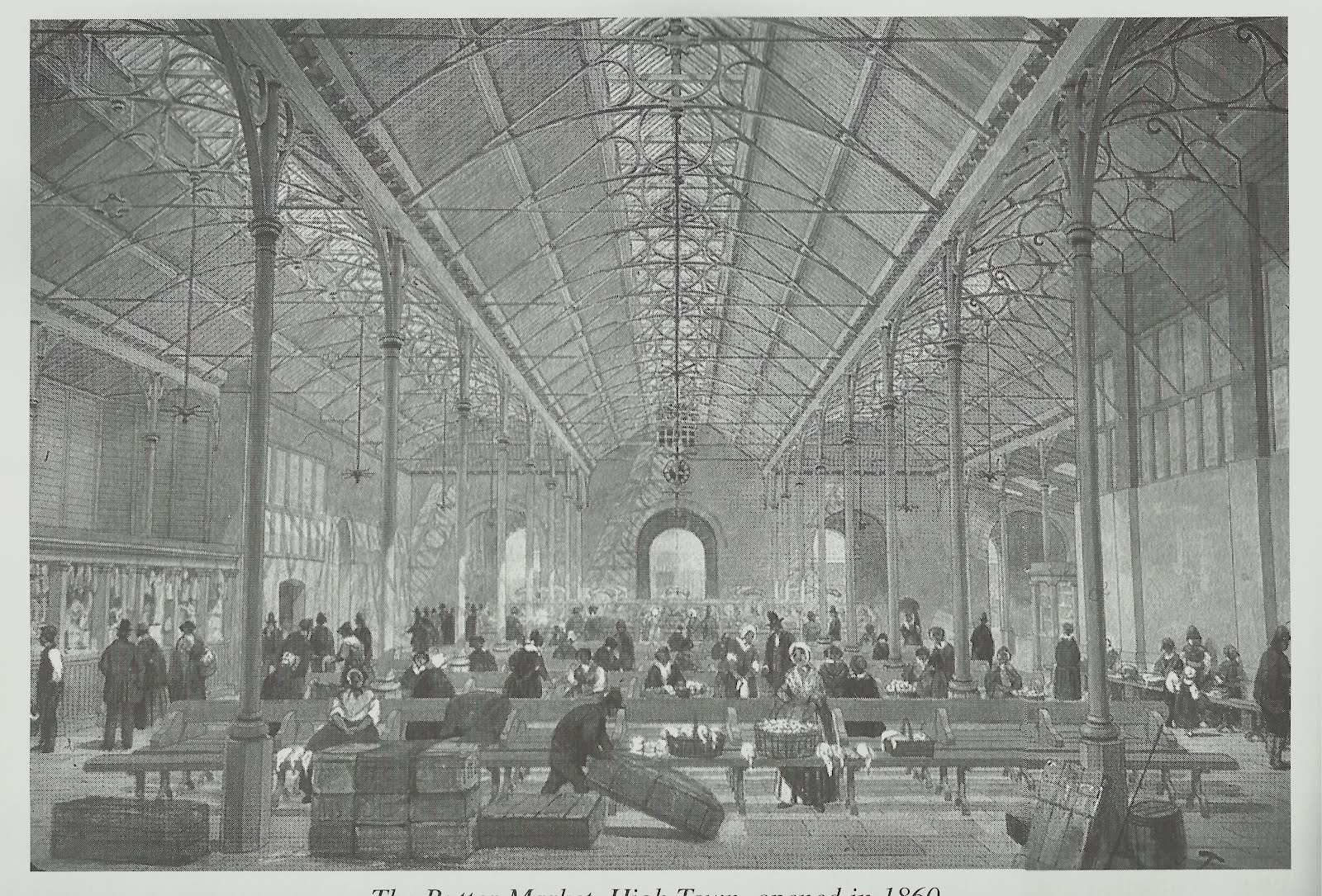
Butter Market Hereford


The first markets on the current site were held for the October Fair in 1810.In those days the market would have sold a variety of goods including butcher's meats, poultry, fish,vegetables,butters and all the items usually sold in a market in those days.
The current market was opened in 1860 with it's iron and glass roof which still remains today but unfortunately out of site at this present time.
The market suffered a fire in 1922.
It was reopened in 1925 and the interior was reconstructed and may have had much same lay out we see it today.
The suspended ceiling was added some time in the 1980's and has not always met with the approval of Herefordian's.The market is due for refurbishment again in 2012 and it would be good if some of the original features were to be seen again.

Many Thanks;Pual Tennant and Keith Taylor for the pics.

Please feel free to add any comments here or on our Facebook page.
http://www.facebook.com/pages/Old-Hereford-Pics/42752762059


Friday, 30 December 2011

Hereford United "Vice Pesidents Club" 1971

With the reopening of the Hereford United Starlite Rooms tonight, thought it would be a good time to show these old pics from 1971 of the then new Vice Presidents Club.These pics are from the clubs brochure for election to the Football League in 1971. Many thanks to John Goulding for the pics.

Tuesday, 11 October 2011

Made in Hereford


A couple of old Cider Flagons from Hereford's past.The flagons were found many years ago by an old lady who lived in Mill Street, Hereford. They were found in her cellar and given to Diana Bone who has kindly photographed them for us.
These vessels were used all the time many years ago when a lot Ale Houses would have brewed there own beers and ciders.Its quite difficult to put a date on them but they are probably from around 1890-1910 time.
We have managed to find a little information on the Henry Chiles Flagon from
Jakeman & Carver's Directory of Herefordshire, 1890 - Henry Chiles, Innkeeper, "No. 10", 142 Widemarsh Street, Hereford
Kelly's Directory of Herefordshire, 1885 - Henry Chiles, "No. Ten", Widemarsh Street, Hereford - under Ale & Porter Merchants and Agents. Also under Wine & Spirit Merchants.
By 1895 "No. Ten" 142 Widemarsh Street (PH) is occupied by Humphrey Owens. It seems to be on the corner of Maylord Street and next to The Guildhall. On the other corner of Maylord Street is the Midlands Railway Co's Goods and Parcels Receiving Office.
From Kelly's Directory of Herefordshire & Shropshire, 1895. [Part 1: Herefordshire]
If the 10 on the jar was the "house number" then at some time it got changed to 142. (We know that Mill Street was renumbered at some point too.)

Very Many Thanks to Diana Bone and her brother John Ruck for all there help with this story.

If anybody has any comments please feel free to leave them here on the blog or visit our Facebook page and leave comments.
http://www.facebook.com/photo.php?fbid=10150310734002060&set=a.171939207059.131420.42752762059&type=1&theater


Sunday, 25 September 2011

King Street Hereford.

Here we have a great old pic of "King Street" with what looks like "The May Fair"possible taken in the 1940s.The grand building on the right was known as "The Residence" one of Hereford's finest buildings at the time.Unfortunately it was pulled down in the early 1960s to make way for what is known today as "Thorpe House".

Pic; Phil Watts

Saturday, 6 August 2011

The Old House 1873

This is a lovely old picture of "The Old House" in Hereford's High Town thought to have been taken about 1873.The picture shows 2 local business's in the old building "Oatfield's Hardware Store" and "Fletcher the Fishmongers". The property was one time part of a row of business's know as "Butcher's Row" which was demolished at the beginning of the 19th century.The picture has other local interest as the young boy standing with his father on the left Mr. Matthew C. Oatfield Snr was later to become in 1921 the 541st Mayor of Hereford, Mr. Matthew Curnow Oatfield Jr.The lady standing next to them is Jane (Poole) who was later married to Mr. Oatfield Snr.
Many Thanks to Mr David Hall for information and picture.
Please feel free to leave any comments here or on our Facebook page.

Sunday, 17 July 2011

Hereford Postcards 1900s


Four lovely old Postcards from around 1900.
The first postcard shows the "Victoria Suspension Footbridge" opened in 1897 in celebration to mark the Royal Diamond Jubilee.
The second postcard shows the "Castle Green" with the "Nelson Memorial" centre and some of its many flowerbeds witch adorned it in those days.
Postcard number three shows the "River Wye" running south though the city passing the "Bishops Meadow" on under the "Victoria Suspension Footbridge" and then on past the "King George's Playing Fields".
Finally postcard number four shows the"Cathedral" from south of the river on the "Bishop's Meadow".

Many Thanks to Mrs Diana Bone for sending in the pics.


Tuesday, 7 June 2011

The Old Wye Bridge, Hereford.


Taken about 1900 this lovely old picture shows The Old Wye Bridge at Hereford.The scene is not too dissimilar to the one we see today. The Bridge and Cathedral obviously still here and the south bank much the same minus the boats. The houses to the left of the bridge remain, but are partially hidden these days by overgrown vegetation on the riverbanks.The building directly behind the bridge was replaced by Sully's Garage, not many years after this picture was taken and later went on to became Mead & Thomkin's.The latter was replaced by the Left Bank Village, opened in 2000 by Dr Albert and Monique Heijn, and was described as a showcase for Hereford. The couple eventually sold the business in 2007. Unfortunately it has not had the best of luck since then and is currently lying empty once again after it went into receivership in December 2010.

Please feel free to add any of your comments below or on our Facebook page http://www.facebook.com/pages/Old-Hereford-Pics/42752762059


Thursday, 12 May 2011

The Bricklayers Arms.

The "Bricklayers Arms" date's back to the mid 1850s and probably looked a lot different when it first became a public house back then.The pub looks much the same on the outside these days as it did here in the 1980s but the inside has radically changed from the old Bar/Lounge format that was popular many years ago. Some years ago the pub changed hands and became the "Jolly Roger"with a huge refit which included a bar built in the style of a pirate ship.At the same time a brewery was installed at the rear of the property and is still there today.These days the pub is known as the "Victory" and is home to the "Hereford Brewery".

Saturday, 7 May 2011

Herefordshire Regiment.

A dispatch from the "War Office" sent to Pte (Acting L/Cpl) Frederick Adams of the "Herefordshire Regiment" for distinguished services in the field during the War of 1914-1918.
Soldiers who are mentioned in dispatches, whilst not awarded a medal, receive a certificate and are entitled to wear a decoration. For 1914-18 and up to 10th August 1920, the decoration consisted of a spray of oak leaves in bronze.
If anyone can help with any information please feel free to contact us at....
oldhereford@gmail.com

http://www.facebook.com/pages/Old-Hereford-Pics/42752762059

Sunday, 21 November 2010

The Old Hereford County Gaol. "Commercial Road"

The " Old County Gaol " in Commercial Road Hereford.

Hereford County Gaol was designed by John Nash who went on to design Regent Street and Marble Arch and to redesign Buckingham Palace. The old bus station office was the end of one of the three wings of Nash's original design. The arched upper windows were the original cell windows. Later, the gaol was redesigned and the end of the wing cut off, to form a house for the governor. The windows were then enlarged to create the building which stands now. The roof above the entrance here was originally flat and was used for public executions. This gaol was opened in 1796 and replaced the earlier County Gaol which was on the site of the Shire Hall.The City Gaol was built later and became first the police station, then the magistrates’ courts. It was also of three wings originally. This is now the Elim Pentecostal Church.
One strange story of this old landmark was published on our sister Facebook involving one of it's so called ghost's.
Jacqueline Thomas, writes she was one of the residents in the flats on the upper storey of Governors House. I discovered that we had a resident spirit shortly after i moved in i was woken regularly in the night and often felt someone tugging my mattress at first i was... a bit frightened. Eventually i got a Spiritualist Medium in to tackle the problem she told me that there was an active spirit in the house she told me his name was Finley and that he was of Jamaican origin he had rickets and a speech impediment the medium communicated with him and he agreed to behave himself which he does and only wakes me in the night when i am having a bad dream. Apparently he was a "runner" and worked at the jail.
Picture; unknown photographer.
Many Thanks; to PJ. Pikes and Jacqueline Thomas for there help with this story.